Blog Post #6: Social Media Tells Stories

Throughout the course of this semester, I have been given the opportunity to take a look at social media in news ways than I ever had before. I personally have had quite a long and rocky journey with my experiences using social media. When I got my first smartphone in the 7th grade, which was an iPhone 4, I mindlessly downloaded some applications that at the time I had no idea the impact they would have on my life in the future. Since then, Instagram and Snapchat have remained the apps that I use the most. As the application icons have changed with time, so have my use and relationships with them.
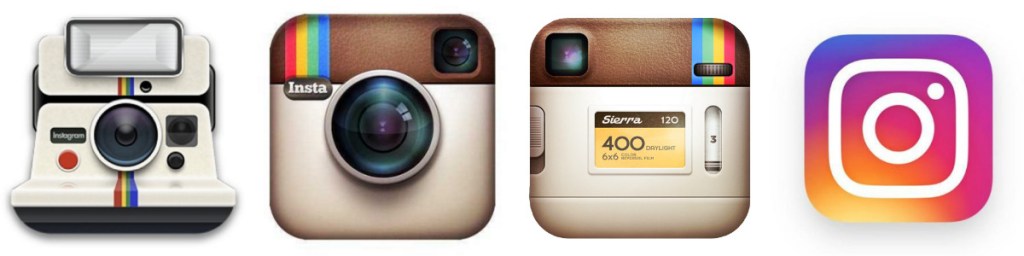
Source: https://www.imore.com/evolution-social-media-icon

Before coming to Barcelona, my social media use had drastically changed since the day I first started using the applications. In 2019, I posted on Instagram, the social media that I use the most, a total of 16 times on my personal account. This may not seem like a small number to some, but to many of the instagram obsessed, “Pics or it didn’t happen” worshiping addicts, this is not a lot. The reason for this is that a couple of years prior, I had to make a drastic shift in my social media usage, especially on Instagram. As a young teen, I had become so obsessed with getting the perfect picture, getting hundreds of likes, and getting dozens of comments on every post. I found that everywhere I went I was not living in the moment because I was obsessing over getting content on my instagram page. This always turned into disappointment, negative thoughts toward myself, and constantly thinking destructive thoughts about my image. After a little bit of growing up and maturing, I was able to take a step back to see that likes were not the most important thing in life.

After a slow and careful second go at social media, I found myself getting on a plane to study abroad in Europe. Now that I had built the tools to protect my mental health from social media destruction, I felt ready to use the platforms in order to share my experiences throughout Europe. In the two short months that I was abroad, I posted to my Instagram account 12 times. Instagram has been my favorite social media throughout my entire social media journey. Despite my love hate relationship with the platform, I now feel that I am able to use it in positive ways not only for myself but in other scenarios.
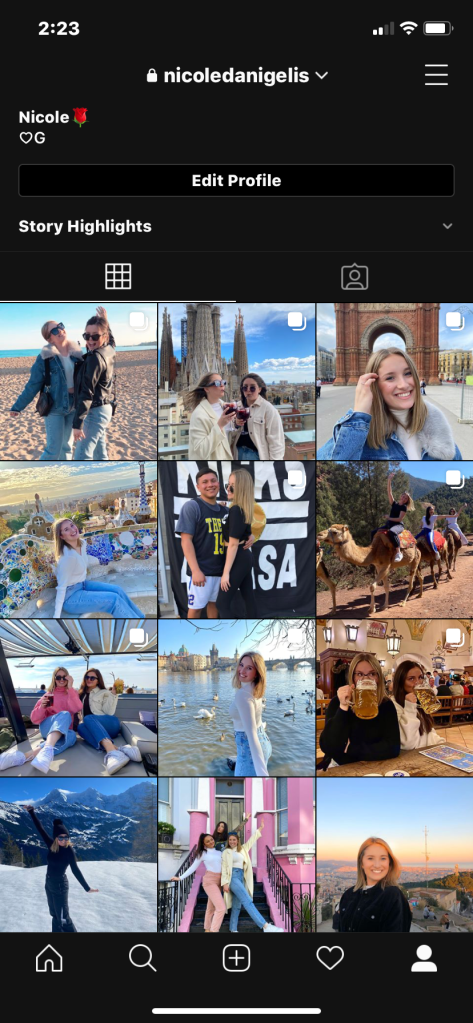
My account is private, so I am unable to properly embed an specific post

A new way that I used social media during my time abroad was through a travel blog. In this blog I recounted my experiences while traveling to share with my family and friends back home in the states. Personal blogging was a new realm that I had not yet tried before. I have had several academic blogs for different classes throughout the years and I have become quite familiar with the workings of Wix and WordPress. Yet, having my own blog about my life was all new to me. When I was a young angsty teen, my family would always tell me that I needed to have my own blog. My aunt even joked and said that I should title my blog “I hate my life” because that was a phrase I loved to use at the time. Ever since it has been on my mind in the back of my head to start my own blog and I felt like this was the perfect chance. I was able to keep track of my experiences all while showcasing and working on my writing skills. The blog ended up being a hit with my family and despite its amateurity, it showed me what I am capable of.

I think that I created a narrative on my blog. My first post was filled with excitement, anxiety, and eager energy which properly demonstrated where I was at the start of my time abroad. As the posts went on I felt more confident in myself and my independent abilities. The tone that was carried through out was one of gratitude, which I solidified in my last post. The abrupt ending my my time abroad shattered my heart into a million pieces, but on my last day I took the time to jot down how I was feeling and I titled it “Dear Mom and Dad.” This last post was a conclusion to my blog, but also a letter of gratitude to my parents for their supporting me through the amazing experience that I had. Looking back at myself when I first landed in Barcelona, to myself on my last day, and to myself now, I have been able to see the narrative of self growth and gratitude throughout. Storytelling has been something that I have found joy in my entire life, and it is what drew me into studying Journalism in college. This experience has shown me the power of storytelling in social media and lead me to falling in love with creating it and sharing it.
Blog Post #5: Social Credit Systems and Social Media

If social credit systems are an upcoming reality in some countries, social media could play an instrumental role in future societies. To understand this statement me must evaluate what a social credit system is and what impact social media currently has on our society.

According to the Wired article titled “The complicated truth about China’s Social Credit Systems” by Nicole Kobie the idea for social credit came up in 2007 and it was implemented in 2014. As of now, there is a difference between the official government system and the unofficial private, corporate versions. A way to break down this system is to see it in our lives. For example, Uber drivers and passengers both rate each other and that impacts the person’s individual score. When your score falls on the lower end, whether it is a correct representation of who you are or not, people will still judge you. China’s social credit system takes that idea and implies it to all aspects of life. The system focuses on people’s behavior and relates it to their trustworthiness. Some examples of this are that if you are caught jaywalking, if you don’t pay your bills, and if you play your music too loud on the train. All of these things affect your score and if your personal score falls too low, you will lose certain rights. If your score falls low enough you can be blacklisted. The article gave an example of what this means through a man named Liu Hu. He is a journalist in China that writes about censorship and government corruption. Because of this, Hu had been arrested, fined, blacklisted, and placed on the list of “Dishonest Persons Subject to Enforcement by the Supreme People’s Court” [1]. This means that Hu is not qualified to buy a plane ticket, buy a train ticket on certain lines, buy property, or take out a loan. “What’s really scary is there’s nothing you can do about it. You can report to no one. You are stuck in the middle of nowhere,” Hu said [1]. This system is developing and the government is working toward having one official program, yet this is only one piece of the country’s surveillance state. China has developed a facial recognition system that has the power to follow a person across entire cities by using their network of 170 million CCTV cameras. There is a tight control on the internet as well. The government has been cracking down on VPNs, making it harder for people to protect their identities online. The country’s firewall has tight controls on web content and it monitors social media. As stated in the article, “China’s social credit system has been compared to Black Mirror, Big Brother and every other dystopian future sci-fi writers can think up. The reality is more complicated — and in some ways, worse” [1]. In the state of the world at this time, it is clear that social credit systems and social media could be easily intertwined.

This can be connected to the Black Mirror episode titled Nosedive. In this episode, there was a similar concept to social credit but it was controlled by social media. Every time people would walk by each other or see a post online they could give a star score from 1 to 5. This caused the successful world to be superficial and plastic because people are always trying to make others like them. The main character of the episode was named Lacie and she started with a 4.2 rating. Every time she worked out she was glued to her phone sending people stars on social media. The basic plot of the episode was Lacie wanting to get her score up. She was invited to be the maid of honor for a bride that had bullied her and not talked to her in years, but she wanted to go and make a speech because everyone there was going to have high scores. When she got out of the taxi at the airport the driver gave her a low rating. When her flight was canceled and she was upset the attendant and people in line all gave her a low rating. When security had to escort her out of the airport they placed a penalty on her score that dropped it extremely low. Because of this, she could only rent a very old car. When the bride found out how low Lacie’s score had become she did not want her to be the maid of honor anymore. Lacie showed up anyway and she ended up in jail covered in mud in a pink dress screaming profanities at the man in the cell across from her. Despite the dramatic element to this show’s episode, I think that this is a proper reflection of what could happen in a social credit system that is fueled by social media.

According to the journal titled “Becoming-Infrastructure: Datafication, Deactivation and the Social Credit System” by Ramon Salim Diab, “China’s Social Credit System (SCS) will come up with these ratings by linking up personal data held by banks, e-commerce sites and social media. […] how many points are on your driving license: these are just a few of the details that the Chinese government will track – to give scores to all its citizens” [2]. This system is giving the government full control of people’s lives as they strive to achieve a good score. Social media plays a huge part in this as it is a big piece of the way that people communicate and express themselves nowadays. When your social credit score is at stake, that can take the individuality and freedom out of social media.

Works Cited

  1. Kobie, Nicole. “The Complicated Truth about China’s Social Credit System.” WIRED, WIRED UK, 7 June 2019, http://www.wired.co.uk/article/china-social-credit-system-explained.
  2. Diab, Ramon Salim. “Becoming-Infrastructure: Datafication, Deactivation and the Social Credit System.” Journal of Critical Library and Information Studies, vol. 1, no. 1, 2017, doi:10.24242/jclis.v1i1.19.

Blog Post #4: The Battle with Wikipedia

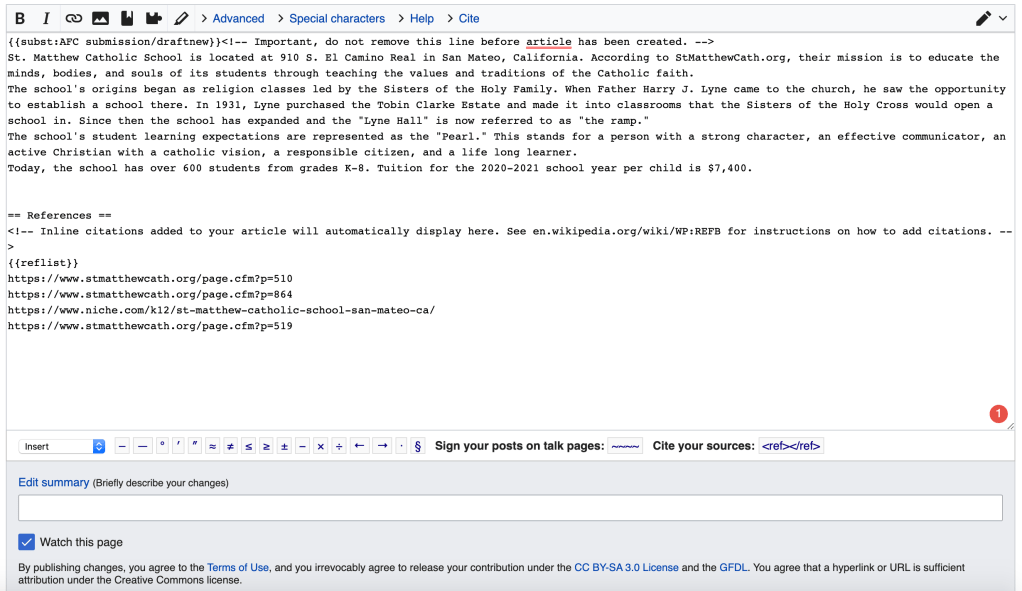
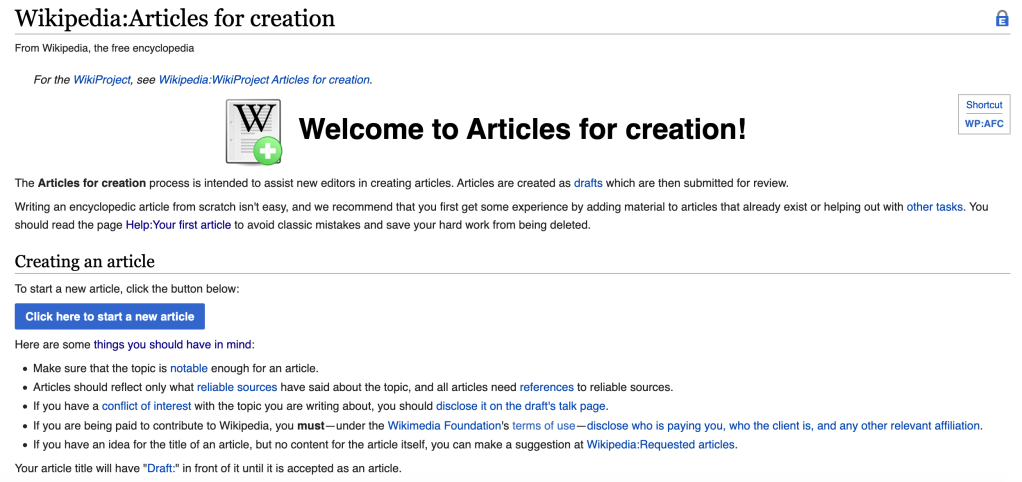
Throughout my attempt to create my own Wikipedia post I struggled a lot. Even with all of the thorough instruction that I received in the directions for this assignment, I found that I came to road block after roadblock. When attempting to come up with an idea of what to create an article about, I had a really hard time coming up with an idea. Everything that I searched already existed. Then I decided to write about the school that I attended from kindergarten to 8th grade. At first, I thought that the help pages themselves were complicated and difficult to read. I personally dislike the format of Wikipedia and I had a really hard time figuring out how to use it. The criteria for the article was something that also was very difficult to follow all at once. First, the article that you create must be “notable” according to Wikipedia. This is something that I did not know was a part of the website because I was always under the impression that it was simple for anyone to add a page or edit an existing one. I think that whether or not an article is “notable” is a bit too subjective for anyone to say and I did not like that not all articles are good enough to go public on the site. I understand why this feature exists so that people do not have the power to create an article about any crazy thing that they can come up with, and at the same time, I think the difficulty of creating a page gives the ones that are currently in existence a bit more credibility.

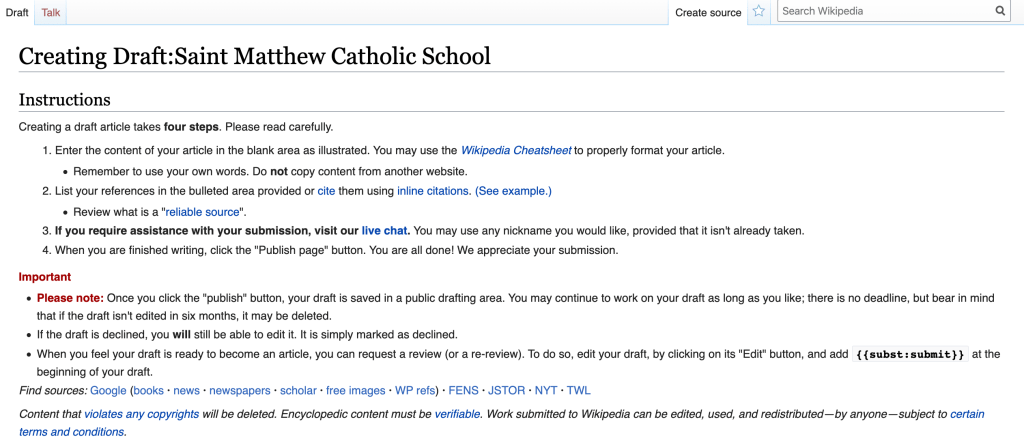
When I sat down to write the article I felt very overwhelmed with the amount of things that I had to read and think about all at the same time. Wikipedia’s formatting for writing and sourcing is much different than any other website that I have used before. I never do well when I have to follow a bunch of different links in order to figure out directions. Because of this, all of the different steps confused me. The basic guidelines for the text were simple in that they did not allow or condone plagiarism.

After I was finished with writing my article I felt very defeated. The way that this website was so foreign to me that I gave up after nearly two and a half hours trying to figure it out. When I clicked “submit article” the page made me fill out one of those tests to confirm that I was not a robot. This feature surprised me but I thought its presence was important. That made me think about how easy it would be for bots to create and submit countless fake articles. I think that fake news and fake websites have created a huge problem in the social media world and they have damaged the reputation of sites like Wikipedia because of that.

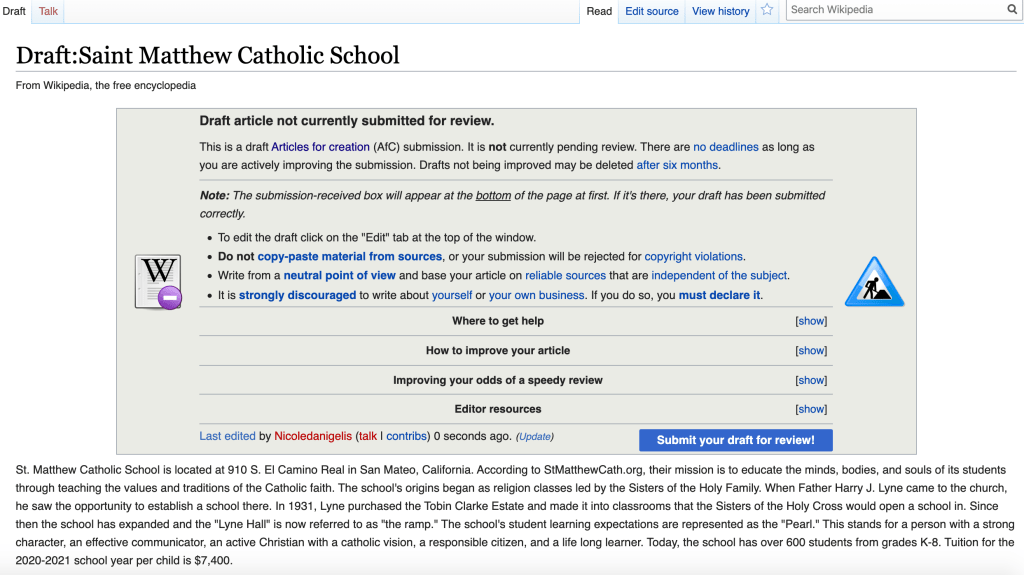
Once my article was submitted, the page refreshed to show me that it was not submitted for review. After all the time I spent trying to figure it out, this showed me truly how hard it is to create a Wikipedia article. I think that what I could have done better was to work on sourcing my information because that is such a crucial piece of Wikipedia articles overall. Also, I think that I should have disclosed my slight conflict of interest on the article’s talk page. Although I felt as though my article was unbiased, someone might want to know if this topic impacted my life in any way.

Overall, it is clear that I had constant struggles throughout my experience in trying to create a Wikipedia article. I have always discredited Wikipedia articles completely because I assumed that anyone anywhere could easily make one. Although this is partially correct, I think that this is no easy task. I still believe that Wikipedia articles are not “reliable” sources, yet if done well I think that proper articles can lead you to some real reliable links in order to learn about the topic at hand.

Blog Post #3: Millennials, Stereotypes, and Digital Natives

The millennial generation consists of people who were born between 1980 and 2000, mostly being the children of baby boomers. Digital Natives, on the other hand, are also known as Generation Z which were the group to follow Millennials up until the early 2010s. Everyone prior to Gen Z are referred to as Digital Immigrants. Millennials are one of the most, if not the most, stereotyped generation. Some of the stereotypes that come with that title are lazy, unmotivated, technology obsessed, entitled, lacking social media etiquette. Some stereotypes of Gen Z are that they have short attention spans, they are multitaskers, technology addicted, and anti social.

As for all stereotypes, there are reasons that they are true. Many people see Millennials and Gen Zers this way because they have acted in this pattern in the past. That being said, stereotypes are always generalizations and never 100% truth. Each of these negative stereotypes that I listed have been researched and debunked by some, and proven to hold truth by others. In my opinion, I have seen the reasons that make these different stereotypes true when evaluating these generations. As I myself am a part of Gen Z I can see first hand the people and mannerisms that keep these stereotypes alive. On the other hand, I wouldn’t say that every single person that was born between 1996 and 2012 has a short attention span.

I thought that this tweet was interesting because it broke down Gen Z into important statistics. I found that it was interesting to see that many of us had a phone by age 10 and spend more than 5 hours a day online. I think that because of the way that technology use has shifted with Gen Z’s actions has sparked a lot of the stereotypes and negative opinions. This is where Millennials come in. They were the last of the old and some of the first in the new digital world. Because of this I think that they have the both the prior knowledge of the past and the total understanding of the now that many older generations do not. According to an article titled “Millenials, New Media and Social Change (Part One).” written by Henry Jenkins, “[Millennials] are also known as the most technologically savvy generation. Even though Generation X’ers were known to heavily consume electronic media because they were born when the Internet was in its infancy, the millennials were born into a media-saturated and consumer-driven culture. Moreover, unlike the members of the previous generations, they were surrounded by digital media technologies since they were infants. In a way, they live in a digital media ecology and in fact are known as “digital natives” [1]. The way that Jenkins explained the generations in relation to technology was well put. I had never thought of Millennials as being more tech savvy but I feel like they were the only generation that lived before the explosion of the Digital Era that truly had the upper hand in terms of technology.

“Since they live in digitalized platforms, millennials are often disconnected from the members of the previous generations. For the most part, rather than being community oriented, they are self-centered and self-absorbed. Perhaps, this why they are known as the “Generation Me”

Henry Jenkins

The fact that this quote, along any of the stereotypes that come along with Millennials, is so negative further emphasizes the struggle between the older and younger generations now. With Millennials right at the cusp of change and Gen Z leading the Web 2.0 era, those who are older have experienced a more drastic change. I think that change is sometimes the scariest thing for people to sit back and watch. Because of this, the older generations have turned their noses up at us younger with our technology use, thus creating the negativity.

This negativity is also highlighted in the article “The Millennial Muddle” by Eric Hoover: “Kids these days. Just look at them. They’ve got those headphones in their ears and a gadget in every hand. They speak in tongues and text in code. They wear flip flops everywhere. Does anyone really understand them?” [2]. It is clear that it is the inability to relate to the ways that children in the Digital Era act that creates the negativity and stereotypes. My grandparents lived in a time where they had a one radio and one television for entertainment at home. We have them in the palms of our hands everywhere we go. They had one landline phone in the house. We have it in our back pocket at all times. These differences are hard for them to picture the drastic difference that their lives would have been like if they were the same as the ones were living.

In the book Digital Natives, Digital Immigrants by Marc Prensky, he describes the reasons for some of these stereotypes: “Lest this perspective appear radical, rather than just descriptive, let me highlight some of the issues. Digital Natives are used to receiving information really fast. They like to parallel-process and multitask. They prefer their graphics before their text rather than the opposite” [3]. I think that the way that he explains Digital Natives was less biased than most. By highlighting these traits like wanting information fast, you can connect the reasons why. For instance, we are used to saying “Hey Siri, what’s the capital of India?” and receiving the answer in an instant. On the other hand, those who have seen the days before Google had a much harder and longer process to access facts. Yet again, I have found that it is our differences and misunderstandings that sprout negative stereotypes that don’t always hold complete truth.

Despite all of the negativity, I think that two of the positive perceptions of my generation are that we tend to be entrepreneurial and tech-savvy. For example, the video below shows a 12 year old app developer. On a less radical scale, I have found that the most simple things that I have done in technology, like creating my travel blog for instance, have amazed my family members senior to me. Overall, stereotypes are just that, stereotypes. They may hold truth in some and not in others. But at the end of the day I feel as though we should all come together as a society to embrace technological advances and change to continue growth.

Explain a positive perception of your generation in terms of new media literacies and participatory culture (use examples). 

  1. Jenkins, Henry. “Millenials, New Media and Social Change (Part One).” Henry Jenkins, Henry Jenkins, 18 Jan. 2018, henryjenkins.org/blog/2017/12/19/millenials-new-media-and-social-change-part-one.
  2. Hoover, Eric. “The Millennial Muddle.” Chronicle.com, 11 Oct. 2009, http://www.chronicle.com/article/The-Millennial-Muddle-How/48772.
  3. Prensky, Marc. Digital Natives, Digital Immigrants. Marc Prensky, 2001.

Blog Post #2: “Friday” by Rebecca Black one of the biggest memes in history

On February 10, 2011 the song “Friday” by Rebecca Black was posted on Youtube. At the time, it did not take long for the Youtube video to go viral for negative reasons. From its “shallow” lyrics, to its “excessive” autotune, people flooded the video’s comments and the rest of social media with hateful words about the video. Through Richard Dawkins’ method of essential characteristics of memes, “Friday” can be clearly analyzed. The first element is fidelity which is the meme’s ability to hook people into contributing their own version of the meme. Within a couple months of the video’s initial

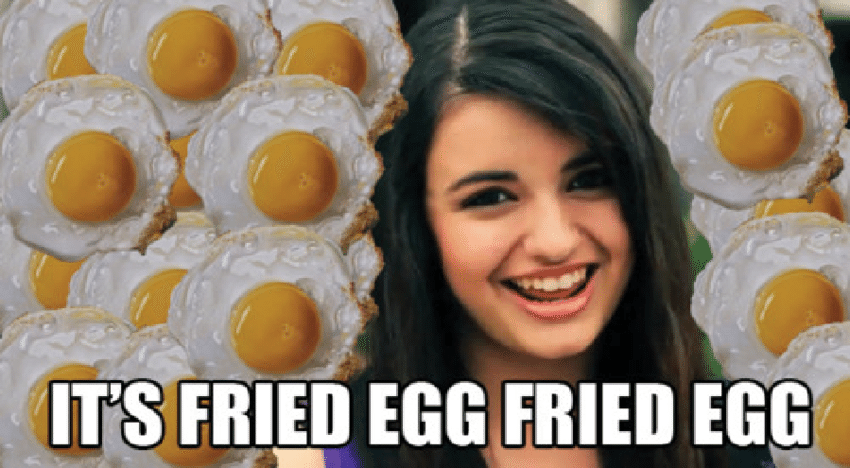
posting, Rebecca Black’s song and face was being shared all around the internet. Today when you search the video’s title or her name, these countless images, videos, and gifs still live on the internet. This example shows how someone decided to play on the words of the song to change it from “It’s Friday” to “It’s Fried Egg.” The second element is fecundity which is the meme’s ability to be transmitted and transformed. This meme also showed this element within a short amount of time.

This example highlights how “Brock’s Dub” remixed this video and changed it from its original meaning. Most of the spreading of these meme were based on the premises of making fun of the video. Some memes can be modified from their initial purpose to spread positive ideas, but this one was spread solely for humor. The third element is longevity which is the meme’s perdurability in memory. This meme hold true in this element as well. As the internet is a perfect place for memes to live on, this one is still visible on Youtube. All of the memes that people created and shared across all platforms like Twitter, Instagram, and

Facebook are all still visible today. This example shows one of the tweets that were shared today, nine years after the posting of this video, of someone in the world still talking about “Friday.” This tweet not only highlights the meme’s impact on pop culture but it also shows the negative consequences that memes can have on who they are featuring.

Today, “Friday” has nearly 140 million views, 1.1 million likes, and 3.4 million dislikes. It is clear through the amount of dislikes on this video overpowering the likes that the reason for its viral spreading was due to this negative aspect. In talking about memes it is important to define what a meme exactly is. As stated in the book, The Meme Machine by Susan J. Blackmore, “When you imitate someone else, something is passed on. This ‘something’ can then be passed on again, and again, and so take on a life of its own. We might call this thing an idea, an instruction, a behaviour, a piece of information… but if we are going to study it we shall need to give it a name. Fortunately, there is a name. It is the ‘meme.’ The term ‘meme’ first appeared in 1976 in Richard Dawkins’s best selling book The Selfish Gene” [1]. Memes are created and have the ability to live on through imitation, or others passing them along. In this case, this meme was not created in the sense of becoming one, yet it was the reactions of people across the internet that established it as one.

Memes on Youtube are a bit different from those that are simply images like Grumpy Cat. According to the article “An Anatomy of a YouTube Meme” by Limor Shifman, “Drawing on YouTube popularity-measurements and on user-generated playlists, a corpus of 30 prominent memetic videos was assembled. A combined qualitative and quantitative analysis of these videos yielded six common features: focus on ordinary people, flawed masculinity, humor, simplicity, repetitiveness and whimsical content. Each of these attributes marks the video as incomplete or flawed, thereby invoking further creative dialogue” [2]. This article highlighted the ways that memes generate on Youtube. As it is a bit easier to copy and paste, or screenshot a Grumpy Cat meme, those on Youtube are a bit more complex to share. Due to their nature of needing to be shared in order to live on, Youtube is a difficult place for memes to get started, yet once they are it is also a great place for them to live on forever. “Friday” is easy to search on Youtube today, but the day it was posted you would have had a more difficult time finding it due to it not having much attention yet.

This meme launched a debate across the internet of whether or not “Friday” was the worst song ever. This all began when Black’s mother paid $4,000 to music producers to help write, record, and film the video. At first the video did not have much attention. It wasn’t until it was featured on Tosh.0 about a month later and that was when it began to explode on the internet. Rebecca Black’s name and song quickly became known everywhere. But what was flooding the internet were endless amounts of hateful comments about the song, video, and just about Rebecca. Being the young girl that she was at the time, all of the hateful comments and death threats were hard to handle. “Friday” changed Rebecca’s life in many ways from becoming homeschooled to being featured in Katy Perry’s music video for “Last Friday Night.” This video showed the power that memes can have on social media and also the negative implications that can arise toward those who are involved or featured.

One thing stands true about all internet memes, that they have a lifespan. “Friday” is something that people today are still talking about, yet it is not trending on Twitter as it once was. These memes come and go, some faster than others. “Friday’s” lifespan can be related to that of the “Harlem Shake.” These memes are much different in their premises as well as in the ways that people responded to them and recreated them. “Friday’s” responses were more so negative in that people were making fun of her, the song, and the music video. On the other hand, the “Harlem Shake’s” responses were those recreating it and putting their own twist on the trend. At the same time, both memes held relevance at the time and they are both songs that I can hear in my head every time I see their name. As stated in the article “Monetizing a Meme: A Case Study on The Harlem Shake” by Zachary McDowell, “While the speed with which the Harlem Shake meme was born, spread, and died was remarkable, dance crazes are nothing new. The Tango, The Twist, The Mashed Potato, The Hustle, and The Macarena are just a few of the dance crazes that swept through the dance halls, living rooms, and discotheques of the US, and around the world throughout the 20th century. These were memes in the pre-Internet, Richard Dawkins sense of the term; pieces of culture that successfully spread, replicated, and transformed into popular phenomena” [3]. Dance memes are something that have exploded in recent years. TikTok is a relatively new social media application that has taken this to the next level with sharing, creating, and spreading your own version of dancing memes.

I too have embarrassingly contributed to my fair share of memes. When “Friday” was most popular, my friends and I created our own version of the music video, yet it never was posted to the internet. Unfortunately there is a video of my somewhere out there on Youtube doing the “Harlem Shake”. Those little things are the reasons that memes exist, and platforms like TikTok have now created spaces for them to spread at speeds that were never possible before.

Works Cited

  1. Blackmore, Susan J. The Meme Machine. Oxford University Press, 2000.
  2. Shifman, Limor. “An Anatomy of a YouTube Meme – Limor Shifman, 2012.” SAGE Journals, https://journals.sagepub.com/doi/abs/10.1177/1461444811412160
  3. McDowell, Zachary. “Zachary McDowell.” Culture Digitally, 24 Oct. 2014, http://culturedigitally.org/2014/10/monetizing-a-meme-a-case-study-on-the-harlem-shake/.

Blog Post #1: Net Neutrality and the Web We Want

When asked to define net neutrality, the simple definition becomes more and more complex as its different elements unfold. Net neutrality can be defined as a the principle that states that Internet service providers should allow access to all areas of the internet regardless of where the content comes from, and without favoring or blocking particular elements. This means that companies like AT&T, Comcast, or Orange should treat all content and users equally. Without net neutrality, or the legislature that enforces it, these companies have the power to block certain information from certain people. This concept may not seem very severe at first glance, but when you begin to think about the implications that the lack of net neutrality has on people, the clear consequences begin to rise. In my opinion, net neutrality is needed in order to allow free speech on the internet for all people.

When I try to imagine an online world in which a tweet that I post may be blocked from the world, a website that I may not be able to reach, or being required to pay more for a strong connection, it feels like something that is not far off. This topic is something that is not new to me, as it has been a huge discussion in many of my classes as an Information Science minor. I have felt passionate about studying the internet at a very young age, as I feel that it is something that is such a huge part of our lives. I think that the lack of net neutrality is impacting our daily freedoms online a little more each day, yet it is something that many people are not aware of.

According to a book titled Virtual Freedom: Net neutrality and Free Speech at the Internet Age by Dawn C. Nunziato, “Censorship by private broadband providers is growing. Most Internet users are unaware of the restrictions on speech imposed by their Internet service providers, and may be surprised to learn that such censorship does not violate the First Amendment or communications laws (as currently interpreted by the courts)” [1].This stuck out to me because I think that the more people realize the importance of net neutrality, the more knowledge they will have about its impact on our freedoms. One good example of spreading the word about this topic is Change.org’s promotion of an internet-wide Day of Action. I think that this creates an online community that helps the flight against our freedom of speech being taken away from us online.

At first I was still a bit confused about the details of what not having net neutrality online means. This example from Timothy Karr’s article titled “People of Color Need the Open Internet” for FreePress.net helped put it in perspective for me:”The open internet allows people of color to tell their own stories and organize for racial justice. When activists are able to turn out thousands of people in the streets at a moment’s notice, it’s because ISPs aren’t allowed to block their messages or websites. The open internet allows people of color and other vulnerable communities to bypass traditional media gatekeepers. Without Net Neutrality, ISPs could block speech and prevent dissident voices from speaking freely online. Without Net Neutrality, people of color would lose a vital platform” [2]. Today, social media has become such an important space for activism and change to spread across societies all around the world at a lightening fast speed that has never been achievable prior to the digital era. This clearly showed me the true impacts that net neutrality can have on our freedom of speech. Movements like #BlackLivesMatter and #MeToo were fueled by the internet and social media platforms. This is a huge example of the negative implications that arise when net neutrality is not prioritized in current legislature.

Throughout my exploration of net neutrality I have realized that I have a lot to learn, and we all do. Often times when I share with others that I am an Informational Science minor they are confused as it is something that seems made up since they have never heard of it before. More and more I realize how lucky I am to have chosen a program that was just getting stated at my University. I feel that it is our job as users of the internet to not sit back and let it, or those who have created it, to control us. I am finding my studies of the internet, social media, and technology as a whole in relation to the spread of information more relevant every day. As Solana Larsen states in her article titled “Who Saved the Web” for the WebWeWant.org, “All this is to say there is hope for the Web. We need to rein in the bad behavior that threatens to hurt us and support the parts of the Web that are most important to us. For too many years, the Web was just something we used and not something we learned about in school. Everyone needs to understand that we have a civic duty to protect the Web and make it a better place” [3]. Prior to this I had not heard of the Web We Want Foundation or their work in promoting net neutrality for all. I think that Larsen’s argument was one that should be talked about more in the mainstream media. It is our job as users to understand the powers that the internet has over us in order to protect our rights and our privacy.

  1. Dawn C. Nunziato, Virtual Freedom: Net neutrality and Free Speech at the Internet Age (Stanford University Press, 2009), https://books.google.es/books?hl=en&lr=&id=S0UkDwAAQBAJ&oi=fnd&pg=PT7&dq=net+neutrality+freedom+of+speech&ots=ZD9_JMaScO&sig=UM0xRMPLDEfRYLAvbKOMfd7pKps&redir_esc=y#v=onepage&q&f=true
  2. Timothy Karr, “People of Color Need the Open Internet: Racial-Justice Coalition Urges the FCC to Preserve Net Neutrality Under Title II” July 20, 2017, https://www.freepress.net/issues/free-open-internet/net-neutrality
  3. Solana Larsen, “Who Saved the Web?” August 14, 2016, https://webwewant.org/news/who-saved-the-web/
Design a site like this with WordPress.com
Get started