On February 10, 2011 the song “Friday” by Rebecca Black was posted on Youtube. At the time, it did not take long for the Youtube video to go viral for negative reasons. From its “shallow” lyrics, to its “excessive” autotune, people flooded the video’s comments and the rest of social media with hateful words about the video. Through Richard Dawkins’ method of essential characteristics of memes, “Friday” can be clearly analyzed. The first element is fidelity which is the meme’s ability to hook people into contributing their own version of the meme. Within a couple months of the video’s initial
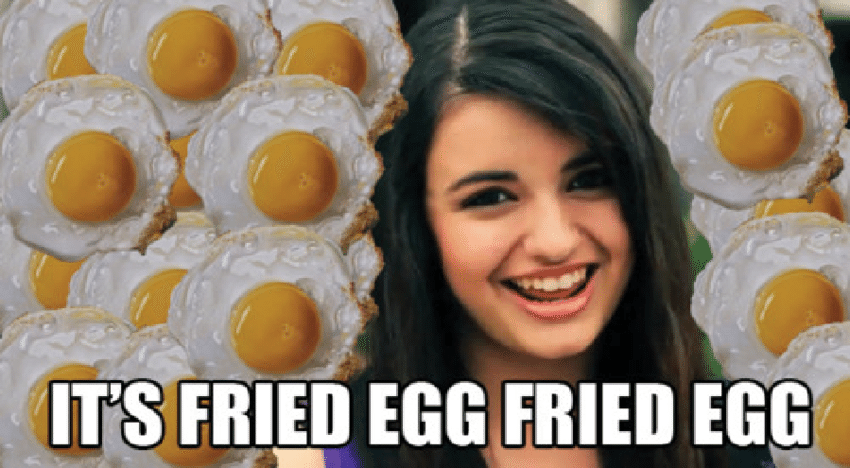
posting, Rebecca Black’s song and face was being shared all around the internet. Today when you search the video’s title or her name, these countless images, videos, and gifs still live on the internet. This example shows how someone decided to play on the words of the song to change it from “It’s Friday” to “It’s Fried Egg.” The second element is fecundity which is the meme’s ability to be transmitted and transformed. This meme also showed this element within a short amount of time.
This example highlights how “Brock’s Dub” remixed this video and changed it from its original meaning. Most of the spreading of these meme were based on the premises of making fun of the video. Some memes can be modified from their initial purpose to spread positive ideas, but this one was spread solely for humor. The third element is longevity which is the meme’s perdurability in memory. This meme hold true in this element as well. As the internet is a perfect place for memes to live on, this one is still visible on Youtube. All of the memes that people created and shared across all platforms like Twitter, Instagram, and
Facebook are all still visible today. This example shows one of the tweets that were shared today, nine years after the posting of this video, of someone in the world still talking about “Friday.” This tweet not only highlights the meme’s impact on pop culture but it also shows the negative consequences that memes can have on who they are featuring.
Today, “Friday” has nearly 140 million views, 1.1 million likes, and 3.4 million dislikes. It is clear through the amount of dislikes on this video overpowering the likes that the reason for its viral spreading was due to this negative aspect. In talking about memes it is important to define what a meme exactly is. As stated in the book, The Meme Machine by Susan J. Blackmore, “When you imitate someone else, something is passed on. This ‘something’ can then be passed on again, and again, and so take on a life of its own. We might call this thing an idea, an instruction, a behaviour, a piece of information… but if we are going to study it we shall need to give it a name. Fortunately, there is a name. It is the ‘meme.’ The term ‘meme’ first appeared in 1976 in Richard Dawkins’s best selling book The Selfish Gene” [1]. Memes are created and have the ability to live on through imitation, or others passing them along. In this case, this meme was not created in the sense of becoming one, yet it was the reactions of people across the internet that established it as one.
Memes on Youtube are a bit different from those that are simply images like Grumpy Cat. According to the article “An Anatomy of a YouTube Meme” by Limor Shifman, “Drawing on YouTube popularity-measurements and on user-generated playlists, a corpus of 30 prominent memetic videos was assembled. A combined qualitative and quantitative analysis of these videos yielded six common features: focus on ordinary people, flawed masculinity, humor, simplicity, repetitiveness and whimsical content. Each of these attributes marks the video as incomplete or flawed, thereby invoking further creative dialogue” [2]. This article highlighted the ways that memes generate on Youtube. As it is a bit easier to copy and paste, or screenshot a Grumpy Cat meme, those on Youtube are a bit more complex to share. Due to their nature of needing to be shared in order to live on, Youtube is a difficult place for memes to get started, yet once they are it is also a great place for them to live on forever. “Friday” is easy to search on Youtube today, but the day it was posted you would have had a more difficult time finding it due to it not having much attention yet.
This meme launched a debate across the internet of whether or not “Friday” was the worst song ever. This all began when Black’s mother paid $4,000 to music producers to help write, record, and film the video. At first the video did not have much attention. It wasn’t until it was featured on Tosh.0 about a month later and that was when it began to explode on the internet. Rebecca Black’s name and song quickly became known everywhere. But what was flooding the internet were endless amounts of hateful comments about the song, video, and just about Rebecca. Being the young girl that she was at the time, all of the hateful comments and death threats were hard to handle. “Friday” changed Rebecca’s life in many ways from becoming homeschooled to being featured in Katy Perry’s music video for “Last Friday Night.” This video showed the power that memes can have on social media and also the negative implications that can arise toward those who are involved or featured.
One thing stands true about all internet memes, that they have a lifespan. “Friday” is something that people today are still talking about, yet it is not trending on Twitter as it once was. These memes come and go, some faster than others. “Friday’s” lifespan can be related to that of the “Harlem Shake.” These memes are much different in their premises as well as in the ways that people responded to them and recreated them. “Friday’s” responses were more so negative in that people were making fun of her, the song, and the music video. On the other hand, the “Harlem Shake’s” responses were those recreating it and putting their own twist on the trend. At the same time, both memes held relevance at the time and they are both songs that I can hear in my head every time I see their name. As stated in the article “Monetizing a Meme: A Case Study on The Harlem Shake” by Zachary McDowell, “While the speed with which the Harlem Shake meme was born, spread, and died was remarkable, dance crazes are nothing new. The Tango, The Twist, The Mashed Potato, The Hustle, and The Macarena are just a few of the dance crazes that swept through the dance halls, living rooms, and discotheques of the US, and around the world throughout the 20th century. These were memes in the pre-Internet, Richard Dawkins sense of the term; pieces of culture that successfully spread, replicated, and transformed into popular phenomena” [3]. Dance memes are something that have exploded in recent years. TikTok is a relatively new social media application that has taken this to the next level with sharing, creating, and spreading your own version of dancing memes.
I too have embarrassingly contributed to my fair share of memes. When “Friday” was most popular, my friends and I created our own version of the music video, yet it never was posted to the internet. Unfortunately there is a video of my somewhere out there on Youtube doing the “Harlem Shake”. Those little things are the reasons that memes exist, and platforms like TikTok have now created spaces for them to spread at speeds that were never possible before.
Works Cited
- Blackmore, Susan J. The Meme Machine. Oxford University Press, 2000.
- Shifman, Limor. “An Anatomy of a YouTube Meme – Limor Shifman, 2012.” SAGE Journals, https://journals.sagepub.com/doi/abs/10.1177/1461444811412160
- McDowell, Zachary. “Zachary McDowell.” Culture Digitally, 24 Oct. 2014, http://culturedigitally.org/2014/10/monetizing-a-meme-a-case-study-on-the-harlem-shake/.
 Nicole Danigelis